
Data is important. Michael Carrick's underlying numbers are not
The numbers don't lie, they just may not be particularly relevant

Anyone who has even been a casual reader of Kwest Thoughts knows that I’m a big data guy. The numbers tell a story. The numbers don’t lie. If you follow the numbers long term, you’re going to be right a lot more often than you’re wrong. The numbers are literally the basis for my annual season preview post.
Manchester United have just done the double over Liverpool. The winning goal was scored by an academy graduate in front of the Stretford End. Despite the most optimistic preseason predictions putting this team maybe in the Europa League, they’ve qualified for the Champions League with three games to spare. It’s a great time to be a Manchester United fan!
If you log onto social media though, the algorithm might feed you a steady diet of detractors moaning about how United’s underlying numbers have gotten worse under Michael Carrick then they were under Ruben Amorim. You might find them annoying or that they’re trying to take away the joy that we should be feeling.
I’m here to tell you two things about this.
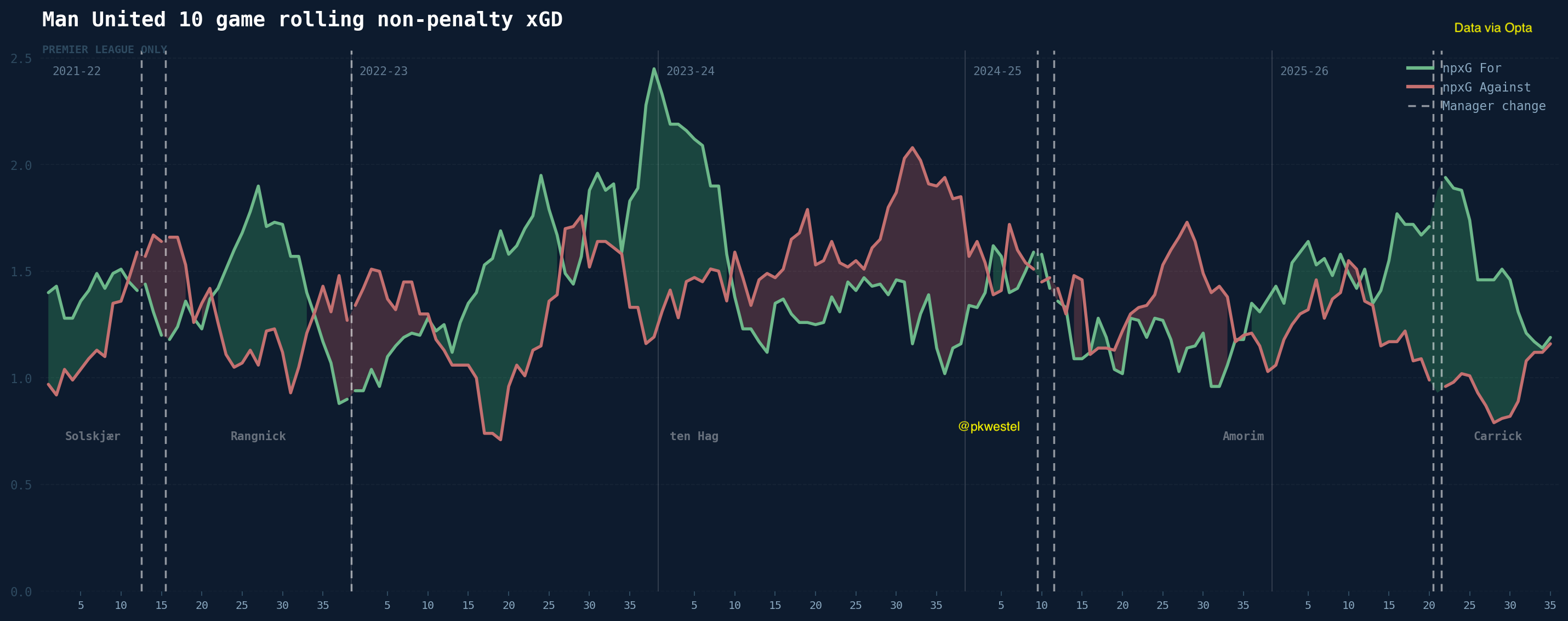
The first is, they’re right! United’s underlying numbers have gotten worse under Michael Carrick. There’s no arguing that. Their non-penalty xG dropped right away and has pretty much stayed put. At first their xGA went down significantly but recently it’s creeped back up enough that the non-penalty expected goal difference has gotten worse.
The second thing is, I don’t care! I don’t care that the numbers are bad slightly worse.
I’m not just saying that because I decided I like Michael Carrick and therefore am going to turn a blind eye to evidence that doesn’t support what I want. There are some valid concerns that are appearing in both the numbers and on the pitch. It’s just, I don’t think any of them are particularly relevant in regards to next season. To understand that we have to dive into why the numbers look like this.
I’m not here to compare the numbers of Carrick’s United to Amorim’s United. There are reasons that some of Amorim’s numbers might be a little inflated but we could argue about that for hours and still get nowhere. I’m here to focus solely on Manchester United under Michael Carrick.
Let’s start here. Per Opta United have a non-penalty xG difference of +0.24 per game since Michael Carrick took over. According to understat United have the third highest NPxGD since Carrick took over. That 0.24 might not be amazing, and it’s certainly not a title contending number, but put it into context, it’s still better than all but two teams in the league.
When Carrick took over he quickly turned United into a very strong defensive unit. They’ve gotten a bit worse in that regard. Their non-penalty xGA went from 0.79 per game over the first seven games to 1.36 over the last seven. Part of that likely comes from instability in the back line. Lisandro Martinez picked up an injury, Harry Maguire was suspended, but choosing to play Leny Yoro over Aiden Heaven is a coach’s decision. There’s definitely some concern there but the argument that it’s partially offset by personnel issues is there. Fine.
The biggest spotlight has been on the xG. Under Carrick, United’s non-penalty xG sits at just 1.31 per game. Across a full season that would be 10th best in the league per Opta. Per understat they are sixth best since Carrick took over. Anyway you look at it, that is not a number reflecting a Champions League quality attack.
That number might be low, but I’m not to fussed about it for next season because it’s a reflection of how United are playing right now.
United’s attack is very simple and conservative. The attackers attack, the midfielders support it. The fullbacks, especially on the right side tend to play much more reserved. They hang back and protect the midfield rather than providing overlapping runs for the winger. This can often leave the winger isolated out wide, and with the wingers holding the width it can in turn isolate the center forward, making it difficult to create numerous high quality chances.
United have made up for this by being really proficient from set pieces - as they were under Amorim this season. They are also very efficient in front of goal, which likely comes from the fact that their big chances are now primarily falling to their attacking players rather than defenders1.
That’s helped United get out in front in matches. In 10 of Carrick’s 14 games in charge United have scored first. It’s at this point where United start to leave a lot of potential xG on the table. It’s not because they’re not good enough, it’s because they’re choosing not to go for it.
Time and time again this season Carrick has essentially shut off the attack in the second half when United have the lead. They cede possession, they drop deeper, they don’t push forward. They’re choosing to focus on defending the lead.
Once United got their breakthrough against Manchester City, they took just three more shots over the final 25 minutes of the game. A week later against Arsenal, they took one shot in the 34 minutes between Patrick Dorgu’s goal and Arsenal’s equalizer. The attack turned back on when things were level.
The same thing happened against Fulham. After United went 2-0 up, they took five shots over the final 35 minutes. One was a rebound of another shot. One came after Fulham equalized. There were no shots between the 74th minute and 93rd minute.
United scored their winner against Everton in the 71st minute. It was their last shot of the match. They took a 2-1 lead against Aston Villa and took just three more shots over the final 20 minutes. They scored just before halftime against Chelsea and took two shots in the second half, with none coming in the final 35 minutes. Holding a 2-0 lead against Brentford United took just three shots in the second half - but really they took their foot off the gas after 15 minutes2. After blitzing Liverpool in the first 15 minutes of the match, they took just three shots the rest of the first half.
It’s not uncommon for teams to get a goal, cede a bit of possession, then as their opponents get more adventurous when trying to chase the game, try to hit them on the counter to run up the score. United aren’t doing the counter attacking part. They’re just ceding possession and defending.
I’m not a fan of this style. It’s not just that I find it boring, it’s that it’s very risky to sit on a one goal lead. Especially in today’s Premier League.
It doesn’t matter how good you’re defending. Mistakes happen. Sometimes there are multiple mistakes, which is how United threw away a two goal lead against Liverpool. Even when you don’t make mistakes, sometimes wonder goals happen. Sometimes you make one mistake and a wonder goal happens (Fulham) wiping out a fantastic performance over the first 80 minutes.
I’d be very concerned if this was how Manchester United were going to play for the foreseeable future. However, I don’t believe that’s going to be the case for one very simple reason.
Michael Carrick was hired to win games.
That’s it. No long term planning, just take the squad you have and win games with them.
Every tactical decision Carrick has made has come down to the simple question of what is the best way to win today’s game with the squad that I have? Every one of those answers leads back to midfield.
Carrick came in and immediately identified who United’s most important players were. Put your best players in their best roles, give them the most opportunities to do what they do best and they’ll be capable of winning games for you. Obviously Bruno Fernandes is your most crucial player but right behind him is Casemiro, a pivotal player to both United’s defending and attack.
At 34 years old Casemiro cannot run up and down a football pitch for 90 minutes anymore. But Carrick figured out very early on that taking Casemiro off the pitch drastically reduced his chances of winning games. As such, he needed to figure out how he could get 90 minutes every week out a player who can’t do it anymore.
Why don’t United aggressively press high? Because for all intents and purposes, Manuel Ugarte is not a Premier League level player, which essentially means Carrick only has two senior central midfielders. He can’t afford to have the two of them exhausted after 60 minutes. Why don’t United’s fullbacks push up and join the attack? Because they need to stay back and protect the middle of the pitch. The last thing you want is for your midfielders to have to cover lateral ground and tire themselves out running all over the place. Why don’t they aggressively counter attack when they have a lead? Because he doesn’t want the game getting stretched out and becoming more taxing on his midfielders. He needs them both to last the full 90 minutes.
There are certainly tactical things you can do to increase the xG but anything would most likely come with a tradeoff of either leaving United more open at the back, or more chances falling to players like Diogo Dalot. Just because you can do something, doesn’t mean you should do it.
Is this really how Carrick wants to play? I’m almost certain it’s not. Just look at the data. His Middlesbrough teams played nothing like this. United’s approach this season has been a direct effect of Carrick making choices based on the current players he has at his disposal.
Thus I can’t take anything that I’m seeing right now and project it over to next season because next season is going to be completely different if for no other reason than Casemiro won’t be here.
United are planning to sign two, maybe three, new midfielders. If United suddenly have four Premier League level midfielders, they’ll be able to be more aggressive as they’ll be able to sub them off when they’re tired. They’ll be able to rotate them to keep them fresh. Maybe next season the fullbacks will become more aggressive going forward - either because United’s midfielders are better equipped to covering the space behind them or because they’ve signed a more aggressive fullback.
The tactical approach of the team is going to look different next season because the team is going to look different. That doesn’t mean we know for sure that Carrick will be able to turn United into world beaters, the same way that we have no idea that anyone else would be able to settle into Manchester United/England and turn United into world beaters. The quality of players United sign this summer - and whether or not they’re actually good and actually perform will dictate that far more than the manager.
When it comes to thinking about next season here’s what’s relevant. Carrick’s knowledge of the scale of the job. His ability to connect with players, understand their strengths and weaknesses, and come up with a plan for how to win games with the ones available to him.
What isn’t relevant are United’s underlying numbers from the back half of this season. The numbers always win out in the end, except when they don’t. The numbers were very much trending in the right direction after Erik Ten Hag’s first season and United dropped off significantly the next season. The numbers were very much trending in the wrong direction at the end of Amorim’s first season. There wasn’t really any suggestion it was going to turn around, but, a few personnel changes were made and things got better at the start of this season…
Numbers don’t lie. They just don’t always tell you the whole story.
Kwestthoughts is a completely free newsletter and there are no plans to change that. If you’ve ever thought about supporting my work more directly now you can “buy me a drink” or leave a tip as a token of appreciation. Thank you for continuing to support me.
There may be an argument that Carrick scaling back United’s pressing has left the players fresher which has helped their finishing, but I haven’t fully completed the research behind this
United took four shots in the first 11 minutes and scored. They then took seven shots over the next 79 minutes
it makes sense
I agree long term some of the issues will be exposed